

How do shift workers adjust their sleep schedule while traveling without completely wrecking themselves? I’ve asked myself that question at 3 a.m. in a hotel room more times than I can count. After eight years of rotating night shifts and a stubborn love for travel, I’ve crashed hard, figured things out the painful way, and landed on strategies that actually work. Your body clock is already confused. Travel just adds jet lag on top of circadian chaos, and that combo can ruin a trip fast.
Why Shift Work Makes Travel Sleep So Much Harder
Most travel sleep advice assumes you have a “normal” schedule to begin with. You wake up at 7, you sleep at 11, and jet lag just shifts that window. Shift workers don’t get that luxury. Your internal clock is already running on a schedule that doesn’t match sunlight, and when you throw time zones into the mix, your body has no anchor point.
I once flew from Chicago to London after finishing a string of night shifts. My body thought it was bedtime at noon London time, which was 6 a.m. Chicago time, which was roughly when I’d normally be winding down after work. Three clocks fighting each other. I spent the first two days in a fog so thick I could barely order coffee. That trip taught me I needed a real plan, not just “sleep on the plane and hope for the best.”
The core problem is that shift workers already carry what researchers call social jet lag, a mismatch between your biological clock and the schedule society expects. Add actual jet lag to that, and you’re stacking two disruptions on top of each other.
Start Adjusting Before You Leave Home
The single most effective thing I’ve done is start shifting my sleep window three to four days before a trip. Not by hours, just by 30 to 45 minutes each day. If I normally sleep from 8 a.m. to 4 p.m. and I’m headed somewhere six hours ahead, I’ll start going to bed at 7:30, then 7:00, then 6:30.
It sounds small. It is small. But those incremental shifts give your circadian rhythm a nudge in the right direction instead of a violent shove.
If you work rotating shifts, this gets trickier because your schedule might not cooperate. In that case, I focus on when I wake up rather than when I fall asleep. Moving your wake time earlier by 30 minutes is usually easier to control, especially if you set an alarm and force yourself out of bed. Pair that with immediate bright light exposure when you wake up, and your body starts recalibrating.

Use Light Strategically, Not Randomly
Light is the most powerful tool you have for resetting your circadian rhythm, and most people use it wrong. They either ignore it completely or blast themselves with light at the wrong time and make things worse.
Here’s the general rule I follow: if you need to shift your sleep earlier (traveling east), get bright light in the morning and avoid it at night. If you need to shift later (traveling west), do the opposite.
I carry a small portable light therapy lamp from Circadian Optics in my travel bag. It’s about the size of a tablet and puts out 10,000 lux. Twenty minutes of that while I eat breakfast in my hotel room does more for my adjustment than any supplement. On the flip side, I use blue-light-blocking glasses from Swanwick starting about three hours before I want to sleep. They look a little goofy, but they work.
The mistake I made early on was sitting in a bright hotel lobby scrolling my phone right before bed. That artificial light was telling my brain it was daytime, and my already confused shift-worker brain believed it.

How Do Shift Workers Adjust Their Sleep Schedule While Traveling Across Multiple Time Zones?
Crossing one or two time zones is manageable. Three or more is where things get genuinely rough, especially for people whose circadian rhythm is already compromised.
My approach for big time zone jumps is to pick a “target sleep time” at my destination and work backward. If I want to sleep at 11 p.m. local time and I’m arriving at 2 p.m., I know I need to stay awake for about nine hours after landing. That means I need to have slept on the plane or the night before, or I’m going to hit a wall.
For eastward travel across five or more zones, I sometimes use a split-nap strategy. Instead of trying to sleep a full eight hours at the “right” time immediately, I’ll take a 90-minute nap in the afternoon (one full sleep cycle) and then sleep a shorter block at night. Over two or three days, I consolidate those into one longer sleep. This approach saved me during a trip to Tokyo after back-to-back night shifts.
For westward travel, things are a bit easier because staying up later feels more natural to most shift workers. You’ve already trained your body to be awake when it shouldn’t be.
Melatonin: What Actually Works and What Doesn’t
I’ll be honest, I was skeptical about melatonin for years. I thought it was basically a placebo. Then I started using it strategically and changed my mind.
The key insight is that timing matters more than dose. Most people take 5 to 10 mg right before bed, but research from the Sleep Foundation and clinical studies suggests that 0.5 to 1 mg taken three to four hours before your target bedtime works better for circadian shifting. You’re not using it as a sleeping pill. You’re using it as a time signal to tell your brain that darkness is coming.
I use Natrol 1 mg fast-dissolve tablets. They’re cheap, widely available, and the low dose doesn’t leave me groggy the next day like higher doses sometimes did.
One warning: melatonin can backfire if you take it at the wrong time. Taking it in the morning when you’re trying to stay awake will shift your clock in the wrong direction. If you’re unsure about timing, the Timeshifter app (originally designed for pilots and astronauts) creates a personalized plan based on your departure time, arrival time, and usual sleep schedule. It even accounts for shift work patterns.
Create a Portable Sleep Environment
Your bedroom at home probably has blackout curtains, a fan for white noise, and a bed you’ve broken in. A hotel room has thin curtains, a hallway full of slamming doors, and a pillow that feels like a bag of rocks. Shift workers already know how important sleep environment is because we’ve been sleeping during daylight for years. Travel just makes us rebuild that setup from scratch.
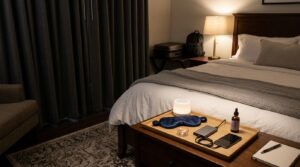
I never travel without three things: a sleep mask (I use the Manta Sleep Mask because it doesn’t press on my eyes), silicone earplugs, and a portable white noise machine. The Lectrofan Micro2 clips to a pillow and runs for hours on a single charge.
Some shift workers I know also bring their own pillowcase from home. It sounds ridiculous, but the familiar scent and texture can actually help your brain relax faster in an unfamiliar environment. I tried it once as a joke, and now I do it every trip. Your brain picks up on those cues more than you’d think.
Caffeine and Alcohol: The Two Traps
Caffeine is a shift worker’s best friend and worst enemy. When you’re traveling and exhausted, the temptation to drink coffee all day is real. I’ve done it. It keeps you functional, but it also destroys your ability to fall asleep at your target time later.
My rule is simple: no caffeine within eight hours of when I plan to sleep. If I’m trying to sleep at 10 p.m. local time, my last coffee is at 2 p.m. This is harder to follow than it sounds, especially when you’re fighting drowsiness at 4 p.m. in a foreign city. But pushing through that afternoon slump with a short walk or cold water on my face has always paid off more than another espresso.
Alcohol is the other trap. A glass of wine at dinner feels like it helps you relax, and it does, initially. But alcohol fragments your sleep cycles and reduces REM sleep, which is exactly what your brain needs most when it’s trying to adjust to a new schedule. I’m not saying never drink on a trip. I’m saying don’t use it as a sleep aid, because it will slow down your adjustment by a day or two.
Exercise and Meal Timing as Clock Setters
Most people overlook this, but when you eat and when you exercise send strong signals to your circadian clock. If you eat breakfast at your destination’s breakfast time, your digestive system starts syncing to that local time zone. Same with exercise.
I try to do some kind of physical activity, even just a 20-minute walk outside, in the morning at my destination. The combination of light exposure, movement, and being upright helps my body accept that this is the new “daytime.” Studies from Northwestern University have shown that morning exercise shifts circadian rhythms forward, which is exactly what you want after eastward travel.
Meal timing is trickier for shift workers because we’re used to eating at odd hours. When I travel, I force myself onto local meal times immediately, even if I’m not hungry. Eating dinner at 7 p.m. local time when my stomach thinks it’s 1 a.m. feels weird, but within two days, my appetite adjusts, and my sleep follows.

Give Yourself a Buffer Day
This is the advice I resisted the longest and now consider the most important. If you can, arrive at your destination one day before you actually need to be functional. That buffer day is for sleeping at odd hours, adjusting, and generally being a mess without consequences.
I used to book flights that landed the morning of a family event or the day a vacation “started.” I’d show up exhausted, irritable, and unable to enjoy anything. Now I build in at least 24 hours of adjustment time. It means an extra night at the hotel, but it means I’m actually present for the trip instead of sleepwalking through it.
For shift workers especially, that buffer day is non-negotiable for trips crossing three or more time zones. Your body is doing double the work compared to a typical traveler’s, and it deserves a head start.
FAQs
Is it harder for night shift workers to recover from jet lag than day shift workers?
Generally, yes. Night shift workers already have a disrupted circadian rhythm, so adding jet lag creates a double whammy. Your body lacks a stable baseline to return to, which means adjustment often takes one to two extra days compared to someone with a consistent daytime schedule. Traveling westward tends to be slightly easier since staying up late already feels natural.
Should shift workers take sleep medication when traveling?
I’d avoid prescription sleep meds as a first option. They mask the problem without actually shifting your internal clock. Low-dose melatonin timed correctly is a better approach for circadian adjustment. If you do use something stronger, talk to your doctor first, especially if you’re combining it with shift work fatigue, because sedation can be unpredictable.
How long does it take for a shift worker to adjust to a new time zone?
The general rule is one day per time zone crossed, but shift workers often need an extra day or two on top of that. If you’re crossing six time zones, expect five to eight days for full adjustment. Using light therapy, melatonin, and meal timing together can cut that down noticeably, sometimes by two or three days.
Can napping help shift workers adjust their sleep while traveling?
Absolutely, but keep naps to 20 minutes or 90 minutes. Anything in between puts you into deeper sleep stages and makes you feel worse when you wake up. I use 90-minute naps when I first arrive at a destination and shorter power naps during the adjustment period. Just don’t nap within four hours of your planned bedtime.
What’s the best app for planning sleep adjustments during travel?
Timeshifter is the best I’ve used. It was built with input from NASA scientists and accounts for flight times, sleep habits, and even shift work patterns. It tells you exactly when to seek light, avoid light, take melatonin, and sleep. The free version covers basic trips, and the paid version handles more complex schedules.
Conclusion
Traveling as a shift worker will never be as straightforward as it is for someone with a 9-to-5 schedule, but it doesn’t have to wreck you either. The combination of pre-trip sleep shifting, strategic light exposure, smart melatonin use, and one honest buffer day has turned my trips from exhausting ordeals into actual vacations. What’s your go-to trick for sleeping in a new time zone?