
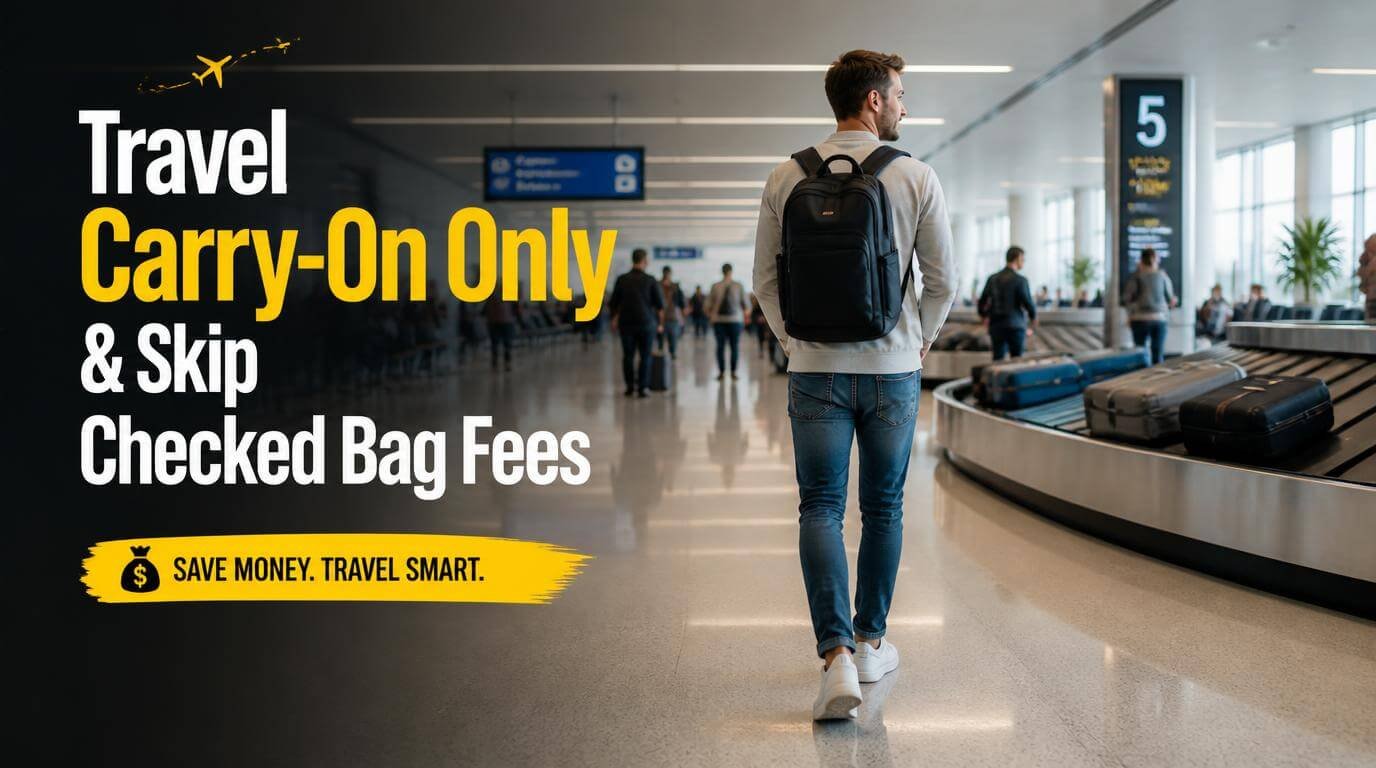
Traveling without checked baggage fees on a strict backpacking budget changed the way I see every single trip. I used to hand over $30, $50, sometimes $70 per flight segment just to bring a suitcase full of stuff I barely touched. That money added up fast, especially when I was hopping between three or four cities in a month. Once I committed to carry-on only, I saved hundreds per trip and moved through airports like a ghost. No waiting at carousels. No lost luggage panic. Just me and one bag.
Why Baggage Fees Destroy a Backpacking Budget
Budget airlines built their entire business model around cheap base fares and expensive add-ons. Ryanair, Spirit, Frontier, AirAsia, and Wizz Air all charge separately for checked bags, and those fees often cost more than the flight itself. I once booked a $19 Frontier flight from Denver to Las Vegas, then watched the total climb to $68 after adding a checked bag.
When you’re backpacking through multiple countries or cities, those charges multiply fast. A two-week trip with four flights can rack up $120 to $280 in baggage fees alone. That’s money you could spend on hostels, street food, or an experience you’ll actually remember. Flying carry-on only eliminates this entire expense category from your budget, and it forces you to pack smarter, move faster, and stress less at every airport.
The math is simple. Every dollar you don’t spend on luggage fees is a dollar you spend on the trip itself.
Pick the Right Bag Before Anything Else
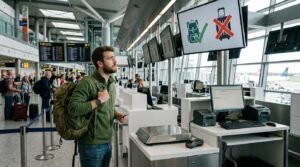
Your bag choice matters more than your packing list. Get this wrong and you’ll either get forced to check it at the gate or struggle with a pack that doesn’t fit your body.
Most budget airlines allow a cabin bag between 40 and 45 liters, but dimensions vary wildly. Ryanair’s standard carry-on limit is 55 x 40 x 20 cm. EasyJet allows 56 x 45 x 25 cm. Spirit wants 56 x 46 x 25 cm but charges for overhead bin access on their base fare. Always check the specific airline’s size limits before you book.
I personally use the Osprey Farpoint 40, and it has been on every trip with me for three years. It fits under most airline cabin bag requirements, opens like a suitcase, and has hip straps for long walks between hostels. The Tortuga Outbreaker 35L and the Cotopaxi Allpa 35L are also solid picks. Avoid anything over 45 liters unless you’ve confirmed it meets your airline’s dimensions.
What About Personal Item Only Fares?
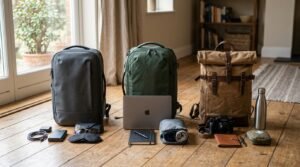
Some ultra-budget flyers skip the overhead bin entirely and fly with just a personal item. Airlines like Spirit and Frontier allow a free personal item (roughly 18 x 14 x 8 inches). If you can fit everything into a bag that size, your flight cost stays at the base fare. The Cotopaxi Tasra 16L and the Patagonia Black Hole 25L both work for short weekend trips using this strategy.
Master the Capsule Wardrobe Approach
Packing light isn’t about suffering through a trip with dirty clothes. It’s about picking versatile pieces that mix, match, and dry quickly.
Here’s what I bring for a two-week trip in warm weather: three merino wool t-shirts, one pair of quick-dry pants, one pair of shorts, five pairs of merino underwear, three pairs of socks, one lightweight hoodie, and one rain shell. That’s it. Merino wool is the secret weapon because it resists odor for days and dries in hours. Brands like Smartwool and Unbound Merino make shirts that look normal enough for a restaurant but perform like athletic wear.
I do sink laundry every three or four days using a small packet of travel detergent (Sea to Summit makes single-use strips that weigh almost nothing). Hang everything on a travel clothesline in your hostel room, and it’s dry by morning. Cold climates require a slightly different approach, layering a down jacket like the Uniqlo Ultra Light Down over your base layers works without eating up bag space.
Roll, Compress, and Organize Everything
How you pack matters just as much as what you pack. I roll every single item of clothing because it reduces wrinkles and saves space compared to folding. But the real trick is compression packing cubes.
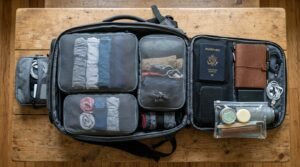
Eagle Creek and Peak Design both make compression cubes that squeeze air out of your clothes and shrink the volume by about 30 to 40 percent. I use three: one for tops, one for bottoms and underwear, and one for dirty laundry. They keep your bag organized so you’re not digging through everything at a hostel at 6 AM while your roommates sleep.
Toiletries go in a clear quart-sized bag to speed through security. I buy solid shampoo bars from Ethique or HiBAR because they don’t count toward your liquid limit. Solid deodorant, a bamboo toothbrush, and a tiny tube of toothpaste round it out. If you need sunscreen or specific products, buy travel-size containers and refill them, or just buy what you need at your destination.
Traveling Without Checked Baggage Fees Means Rethinking Your Tech
Electronics are usually the heaviest items in a backpacker’s bag, and they’re the hardest to cut. But you probably don’t need everything you think you do.
I travel with my phone, a compact power bank (Anker 10000mAh), one universal adapter, and a single charging cable. That’s four items. I stopped bringing a laptop on trips under three weeks because my phone handles navigation, bookings, messaging, and even light photo editing through Snapseed. If you absolutely need a laptop, go with something ultralight like a Chromebook rather than hauling a full-size machine.
Skip the bulky camera unless photography is genuinely your thing. Modern phones shoot incredible photos, and the weight savings from leaving a DSLR at home is significant. One exception: if you’re an underwater or adventure photographer, a GoPro Hero weighs almost nothing and earns its spot.
The Cable Tangle Problem
Buy a small cable organizer pouch. I use a generic one from Amazon that cost $8, and it keeps my charging cable, adapter, earbuds, and power bank in one spot. Without it, these small items spread across every pocket in your bag and take forever to find.
Know Your Airline’s Fine Print
This is where people mess up. You pack perfectly, you measure your bag, and then you show up at the gate only to get hit with a fee because you missed a policy detail.
Budget airlines change their baggage policies constantly. Wizz Air restructured their carry-on rules multiple times in 2023 and 2024. Spirit introduced new personal item sizing requirements. Ryanair tightened enforcement on overhead bin access for non-priority passengers. Always check the airline’s official baggage page within 48 hours of your flight, not a third-party booking site, because those often display outdated information.
Some airlines weigh carry-on bags at the gate. AirAsia enforces a 7 kg cabin bag limit strictly in Southeast Asia. I’ve seen travelers forced to check bags and pay full fees because they were 0.5 kg over. If your airline weighs bags, wear your heaviest items (jacket, boots, bulkiest clothing) onto the plane instead of packing them.
FYI, booking through the airline directly rather than through sites like Kiwi or third-party OTAs usually gives you clearer baggage terms and easier disputes if something goes wrong.
Souvenirs and the Return Trip Problem
Going out carry-on only is easy. Coming home is the challenge, because you’ve probably picked up souvenirs, gifts, or random things along the way.
My strategy: leave room in your bag from the start. I intentionally pack my outbound bag about 80% full. That gives me space for a few small items I pick up during the trip. I also mail larger souvenirs home through local post offices, which is almost always cheaper than paying a checked bag fee. Sending a 2 kg package from Thailand to the US via Thailand Post costs around $15 to $20. A checked bag on the return flight would cost $35 to $60.
Another trick: buy flat, lightweight souvenirs. Postcards, small prints, scarves, spices, and jewelry take up barely any space. Skip the ceramic plates and carved wooden statues unless you’re willing to pay for shipping.

Use Packing Lists and Weigh Before You Leave
Every experienced carry-on traveler I know uses a packing list. Not because they can’t remember what to bring, but because a list forces you to evaluate every item before it goes in the bag. If it’s not on the list, it doesn’t come.
I keep a Google Doc with my standard packing list and adjust it for each trip based on climate and duration. Before I leave, I weigh my packed bag with a cheap luggage scale (you can grab one for $10 on Amazon). Knowing your exact weight before you get to the airport removes all the anxiety about gate enforcement.
IMO, the biggest packing mistake backpackers make is bringing “just in case” items. That extra pair of shoes, the book you might read, the formal outfit for a night you probably won’t have. Every “just in case” item is dead weight that pushes you closer to needing a checked bag. If you haven’t used something on your last three trips, delete it from the list permanently.
Frequently Asked Questions
Can I really travel for two weeks with only a carry-on bag?
Absolutely. I’ve done three-week trips across Southeast Asia and Europe with a 40-liter backpack. The key is quick-dry clothing, doing laundry every few days, and being honest about what you actually wear versus what sits in your bag untouched. Once you try it, going back to checked luggage feels ridiculous.
What if my airline charges for overhead bin carry-on bags?
Some airlines like Spirit and Frontier charge for overhead bin access on their cheapest fares. You can either upgrade your fare tier, which sometimes costs less than a checked bag, or downsize to a personal-item-only bag. Compare the costs before booking and factor baggage into your total flight price.
How do I handle toiletries when traveling without checked baggage fees?
Switch to solid toiletries wherever possible. Solid shampoo bars, solid deodorant, and bar soap don’t count toward your liquid limit. For liquids you can’t replace, use refillable silicone bottles in a clear quart-sized bag. Buy bulky items like sunscreen at your destination to save space and avoid liquid restrictions.
Is carry-on only realistic for cold weather destinations?
It takes more planning, but yes. Wear your bulkiest layers onto the plane, including your heaviest jacket and boots. Pack a compressible down jacket, merino base layers, and one pair of insulated pants. Layering systems take up far less space than heavy standalone winter garments, and merino wool keeps you warm without bulk.
What happens if gate agents force me to check my bag?
It happens occasionally, usually on small regional planes with limited overhead space. If the airline forces you to gate-check for operational reasons, they typically do it for free. But if your bag exceeds their size or weight limit, you’ll pay the fee. Avoid this by knowing your airline’s exact measurements and weighing your bag before you leave home.
Conclusion
Traveling without checked baggage fees on a strict backpacking budget is one of those skills that pays for itself on every single trip. Once you get your system dialed, you’ll wonder why you ever dragged a full suitcase around in the first place. What’s the one item you always overpack that you could probably leave behind?