
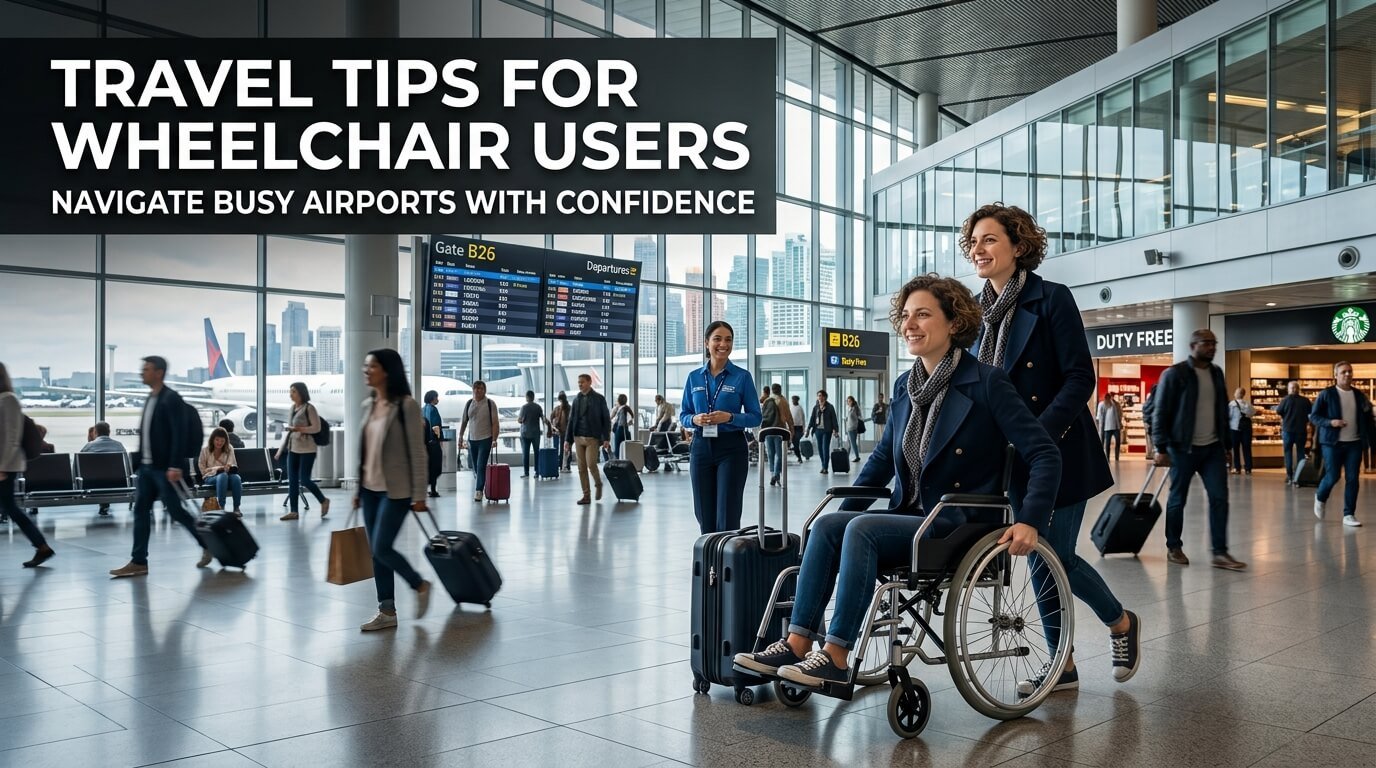
Honestly, the best travel tips for wheelchair users navigating crowded international airports come from people who have actually white-knuckled it through a chaotic terminal at rush hour. I’ve been that person, stuck behind a wall of rolling suitcases in Dubai with no clear path to my gate, watching the clock and sweating through my shirt. Airports aren’t always built with us in mind, but you can absolutely make them work. Here’s everything I’ve figured out after years of doing exactly that.
1. Call the Airline 48 Hours Before Your Flight
Most airlines have dedicated accessibility desks, but they’re useless if you don’t call ahead. I contact the airline at least two days before departure to confirm wheelchair assistance, gate-to-gate service, and any specific equipment I’m bringing. Don’t just rely on what you checked during booking.
I once assumed my online request went through at Heathrow. It didn’t. I sat at the gate for 40 minutes waiting for someone who was never dispatched. Now I call, get a confirmation number, and write down the agent’s name. Redundancy is your best friend when airports get busy.
2. Pick Your Seat Strategically
Aisle seats near the front of the cabin make boarding and deplaning so much faster. If you use a manual wheelchair, you already know that every extra row means more time in the narrow aisle chair they transfer you into.
Bulkhead seats give you more legroom, but they often have fixed armrests that don’t lift. That’s a problem if you need a lateral transfer. I always call to ask about movable armrests before selecting a bulkhead row. Some planes have them, some don’t, and seat maps online rarely tell you this.
3. Arrive Earlier Than You Think You Need To
I know “arrive early” sounds obvious. But for wheelchair users at crowded international airports, early means something different. I aim for three hours minimum on international flights, sometimes three and a half if I’m flying out of a massive hub like JFK, Frankfurt, or Singapore Changi.
Security screening takes longer when you can’t stand for the body scanner. Customs lines move at their own pace. And wheelchair assistance staff sometimes juggle multiple passengers at once, so there can be real wait times. The buffer keeps your blood pressure in check.
4. Protect Your Wheelchair Like It’s Worth More Than Your Luggage
Because it literally is. A good custom wheelchair costs thousands, and airlines break them more often than anyone wants to admit. I use a gate-check tag every single time and watch them load it if I can see the jet bridge window.
Take photos of your chair before you hand it over, every angle, every component. If anything gets damaged, you’ll need documentation for a claim. I also remove any detachable parts like cushions, joystick covers, or side guards and carry those in my lap bag. The less they can snap off, the better.
5. Learn the Airport Layout Before You Land
Most major international airports publish terminal maps online. I spend 10 minutes studying the layout before every trip. Where are the accessible bathrooms? Where’s the elevator versus the escalator bank? Which terminal has the train connector?
Google Maps actually has indoor mapping for a lot of large airports now, including Heathrow, Narita, Dubai International, and many others. Knowing that your connecting gate is a 20-minute push across a terminal changes how you plan your layover. I’ve rerouted connections specifically because I knew a terminal transfer involved a bus with no ramp.
6. Travel Tips for Wheelchair Users: Master the Security Line
Security is where crowded airports feel the most chaotic, and where wheelchair users often feel the most exposed. You’ll typically get pulled to a separate screening area. Sometimes it’s fast. Sometimes you’re waiting while three TSA agents debate who handles the pat-down.
Here’s what speeds things up: wear slip-on shoes, keep your liquids bag on top of your carry-on, and don’t wear anything with excessive metal. I also carry a small printed card explaining my mobility equipment in the local language of wherever I’m traveling. It saves a lot of confused back-and-forth at security checkpoints in non-English-speaking countries.
7. Use the Airport’s Own Assistance Service
Almost every major international airport has a dedicated Passengers with Reduced Mobility (PRM) service. In Europe, it’s a legal requirement under EC Regulation 1107/2006. You can request assistance directly through the airport’s website, usually at least 48 hours in advance.
These services cover everything from check-in to boarding. At Amsterdam Schiphol, I’ve had excellent experiences with their PRM team. At Rome Fiumicino, it was hit or miss. The quality varies, so I always carry my own snacks, phone charger, and patience, because sometimes you’re waiting in a holding area longer than expected.
8. Pack a Small “Survival Kit” in Your Carry-On
This is something I wish someone had told me years ago. My carry-on always has a multi-tool (checked, obviously), spare catheter supplies if needed, a portable phone charger, pain medication, a reusable water bottle, and a compact tire repair kit for my manual chair.
Airports are unpredictable. Flights get delayed. Assistance staff vanish. Having your essentials within arm’s reach means you’re never fully dependent on someone else’s timeline. I also keep a copy of my equipment specs and insurance info in my bag, just in case my chair gets damaged or lost.
9. Handle Layovers With Extra Caution
Long layovers in crowded airports sound manageable until you realize you need to clear immigration, switch terminals, and re-enter security, all on a timeline that doesn’t account for wheelchair assistance delays.
I never book connections under two hours internationally. Three is better. If the layover is very long, some airports have accessible rest areas or lounges. Priority Pass gets you into lounges worldwide, and many of them have step-free access. I’ve spent a six-hour layover in an Istanbul lounge and it was infinitely better than sitting at a gate with no accessible charging station.

10. Speak Up When Something Isn’t Working
This one’s personal, and I get that not everyone feels comfortable doing it. But I’ve learned that politely advocating for yourself at the airport makes a massive difference. If the assistance staff parks you somewhere and disappears, find a desk agent. If the accessible bathroom is locked, ask someone to open it. If your chair comes off the plane damaged, report it before you leave the airport.
Airlines and airports respond to documented complaints. I’ve gotten full repairs covered, flight credits, and policy acknowledgments simply because I spoke up in the moment and followed up in writing. Your comfort matters, and no one will prioritize it unless you do.
11. Consider Traveling With a Compact or Travel-Specific Chair
If you’re a manual chair user and you fly frequently, a travel wheelchair can save you a lot of stress. Brands like TiLite, Ki Mobility, and ROHO make lightweight, foldable options that fit in overhead bins or slim cargo holds.
My everyday chair is heavier and bulkier, so I use a compact folding frame for international trips. It’s not as comfortable for daily life, but it fits through narrow jet bridges, folds for security, and survives the cargo hold better because it has fewer breakable parts. The trade-off is worth it for peace of mind.
12. Know Your Rights in Different Countries
Accessibility laws vary dramatically from one country to another. The U.S. has the Air Carrier Access Act. The EU has its own regulations. But in many parts of Asia, Africa, and South America, protections are thinner or inconsistently enforced.
Before I travel somewhere new, I research local disability rights laws and airport accessibility policies. The International Air Transport Association (IATA) website has a solid overview of global standards. Knowing what you’re legally entitled to gives you leverage when things go sideways, and it helps you set realistic expectations so you aren’t blindsided.
Frequently Asked Questions
Can I stay in my own wheelchair until I reach the airplane door?
Yes, at most airports you can remain in your personal wheelchair all the way to the jet bridge. Gate-check your chair there, and airline staff will transfer you into a narrow aisle chair for boarding. Always confirm this option when you check in so ground crew are prepared for you at the gate.
What happens to my electric wheelchair during the flight?
Electric wheelchairs get stored in the cargo hold. Airlines require you to disconnect the battery, and most accept lithium-ion batteries under 300 watt-hours. Bring your battery documentation and check your airline’s specific policy beforehand. I always tape my joystick down and put fragile parts in my carry-on to prevent damage.
Are airport wheelchair assistance services free?
Yes, airport assistance for passengers with reduced mobility is free at every major international airport. You don’t need to tip, though many assistance staff appreciate it. Book the service at least 48 hours ahead through your airline or the airport’s PRM desk for the smoothest experience.
What should I do if my wheelchair gets damaged during a flight?
Report the damage immediately at the airport before leaving the arrivals area. Take photos, fill out a written damage report with the airline’s baggage desk, and keep every receipt. Airlines are legally responsible for repairing or replacing mobility equipment they damage, so document everything carefully while you’re still on-site.
How do wheelchair users handle immigration lines at busy airports?
Most international airports have accessible immigration lanes or priority processing for passengers with mobility needs. Ask your assistance escort to direct you there. At some airports, like Dubai and Singapore, staff will take you through a separate channel entirely. It’s inconsistent, so always ask as soon as you land.
Conclusion
Flying as a wheelchair user through packed international terminals isn’t effortless, but it doesn’t have to feel like a battle either. A little planning, some self-advocacy, and knowing your rights go a long way toward making the whole experience smoother. What’s the one airport that surprised you, for better or worse, with its accessibility?